
There comes a point where the soul grows tired of being explained.
Tired of labels.
Tired of theories.
Tired of endlessly trying to define every inner experience into something neat and understandable.
The world often speaks about healing, spirituality, awakening, detachment, mindfulness, and enlightenment as if they are destinations with clear instructions. Everywhere we look, people are debating philosophies, quoting ancient teachings, and turning deeply human experiences into intellectual discussions.
But sometimes, beneath all those conversations, there is simply a tired human heart searching for rest.
Not perfection.
Not transcendence.
Just rest.
If you are reading this essay and something quietly stirs inside your chest, perhaps this piece is not meant to teach you another spiritual concept. Perhaps it is simply meant to sit beside you for a little while.
Because what I am experiencing lately does not feel like a theory anymore.
It feels alive.
It breathes through ordinary moments. Through silence. Through grief. Through soft mornings and emotionally heavy evenings. Through washing dishes, touching wet soil, sitting alone with uncomfortable feelings, and learning how to stop running from myself.
For a long time, I thought peace was something I needed to achieve someday. I imagined it as a final destination waiting beyond emotional mastery. I believed I would eventually arrive at a version of myself untouched by fear, attachment, sadness, insecurity, or longing.
But life slowly showed me something entirely different.
Peace was never hiding at the end of self-perfection.
Peace began appearing the moment I stopped fighting my humanity.
And perhaps that realization changed my life more than any philosophy ever could.
The Quiet Exhaustion of Fighting Yourself
For many years, I believed emotional attachment was something I needed to overcome in order to become wiser, calmer, or spiritually mature.
Everywhere I looked, I encountered the same message in different forms: attachment creates suffering. If you want inner peace, you must learn to let go. You must detach from expectations, outcomes, emotions, relationships, and desires.
At first, this teaching sounded liberating.
But over time, I unknowingly turned it into violence against myself.
I became obsessed with trying not to need anything too deeply. Whenever I noticed attachment growing inside me, I immediately tried to cut it away before it could become dangerous. I monitored my emotions constantly, trying to remain calm, detached, and unaffected.
I thought this was wisdom.
In reality, I was exhausted.
The harder I tried to eliminate attachment, the more tense my inner world became. My chest often felt tight. My thoughts became crowded with self-correction. I was no longer living naturally because part of me was always trying to control the rest of me.
I did not realize it then, but I had turned spirituality into another impossible standard.
I was trying to become untouchable.
But human beings were never meant to live untouched.
We were built to feel.
To love.
To grieve.
To long.
To care.
To become attached.
And perhaps suffering does not come from attachment alone, but from the shame we place upon our own humanity.
One day, after years of quietly fighting myself, something inside me became too tired to continue.
So I stopped.
Not dramatically.
Not perfectly.
Just honestly.
Instead of trying to destroy attachment, I decided to sit beside it.
That simple shift changed everything.
Learning How to Sit Beside Attachment
At first, sitting with attachment felt uncomfortable.
My mind wanted solutions. My ego wanted certainty. Part of me still believed uncomfortable emotions needed to be fixed immediately before they became overwhelming.
But instead of reacting, I tried something new.
I stayed.
I allowed longing to exist without immediately silencing it. I allowed fear to speak without treating it like an enemy. I allowed sadness to move through my body without rushing to escape it.
And slowly, I began understanding something I had never fully realized before:
Peace is not created by eliminating emotion.
Peace is created by ending the war against emotion.
That realization softened something very deep inside me.
I no longer needed to become emotionally flawless in order to deserve inner peace. I no longer needed to amputate parts of myself just to feel spiritually “evolved.” I could remain fully human while also becoming more peaceful.
There is a profound difference between awareness and suppression.
Suppression says:
“This feeling should not exist.”
Awareness says:
“This feeling is allowed to exist without controlling me.”
That distinction changed the way I relate to myself entirely.
Now, when attachment appears in my life, I no longer panic the way I once did. I no longer interpret emotional vulnerability as weakness. Instead, I try to meet attachment gently, almost like welcoming an old friend into the room without allowing it to take over the entire house.
And strangely, the less I resist attachment, the less power it has over me.
The Beautiful Paradox of Letting Go
One of the deepest truths I have discovered is that genuine love often becomes possible only when we stop trying to possess what we love.
For years, I misunderstood the meaning of letting go.
I thought letting go meant emotional distance. I imagined peaceful people as individuals untouched by longing or grief. I believed surrender meant becoming detached from life itself.
But true surrender feels very different from emotional numbness.
True surrender is soft.
It allows you to love deeply while also accepting impermanence.
Now, when I care for someone or something, I no longer try to close my fist around it. I try to hold it with open hands instead.
I let myself appreciate the existence of what is here today without demanding guarantees about tomorrow.
This does not mean I stop feeling attached.
It simply means attachment is no longer rooted in control.
Because there is an enormous difference between loving something and trying to own it.
One creates appreciation.
The other creates fear.
I think many of us suffer because we confuse love with possession. We cling tightly to people, identities, expectations, and experiences because we are terrified of loss. We want certainty in a world built entirely upon change.
But life has never promised permanence.
Seasons change.
People change.
Bodies change.
Relationships change.
Even our inner selves change.
And perhaps peace begins when we stop demanding permanence from a temporary world.
There is grief inside this realization, yes.
But there is also freedom.
Because once you stop trying to imprison life into certainty, you can finally begin experiencing it more fully.
Becoming a Silent Witness to Yourself
I want to be honest about something: learning to simply witness my inner world without interfering was one of the hardest things I have ever practiced.
The ego naturally wants control.
It wants comfort.
It wants reassurance.
It wants immediate resolution.
Whenever emotional discomfort appeared, my instinct was always to escape it quickly. I distracted myself, analyzed everything excessively, or tried to “heal” myself as efficiently as possible.
Stillness felt unbearable at times.
Especially when unresolved emotions surfaced.
There were moments when sitting quietly with my own thoughts felt more painful than the thoughts themselves. My body would tense. Anxiety would rise. My mind would desperately search for ways to regain certainty.
But little by little, something changed.
The longer I remained present without immediately reacting, the more I realized emotions behave like weather.
They move.
They shift.
They rise and soften naturally when we stop trapping them inside resistance.
I began noticing that suffering often intensified not because emotions were inherently unbearable, but because I constantly fought against their existence.
The moment I stopped demanding emotional perfection from myself, an enormous amount of energy returned to me.
For years, so much of my life force had been consumed by internal conflict.
Trying to control emotions.
Trying to control outcomes.
Trying to control relationships.
Trying to control uncertainty.
Trying to control myself.
It was exhausting.
And when that inner war finally softened, peace slowly entered the empty space that resistance left behind.
Not dramatic peace.
Not mystical transcendence.
Just a quiet, grounded sense of finally being able to breathe again.
A Reflective Essay About Peace in Ordinary Life
One of the most surprising things about healing is how ordinary it often looks from the outside.
For a long time, I imagined spiritual growth as something extraordinary. I thought peace would arrive through dramatic revelations or perfect meditation practices. I assumed awakening would feel cinematic.
Instead, peace began appearing in small and deeply human moments.
In slow mornings.
In silence.
In touching the earth with my bare hands.
In making tea.
In hearing rain against the window.
In allowing myself to cry without shame.
In learning how to rest without guilt.
The older I become, the more I realize that healing rarely announces itself loudly.
Most transformation happens quietly beneath the surface.
Like roots growing underground.
Invisible.
Patient.
Alive.
Modern life constantly teaches us to chase intensity. We are encouraged to optimize ourselves endlessly, to move faster, improve faster, heal faster, achieve faster.
But the nervous system does not bloom under constant pressure.
Neither does the heart.
Sometimes healing begins the moment we stop trying to turn ourselves into projects needing endless correction.
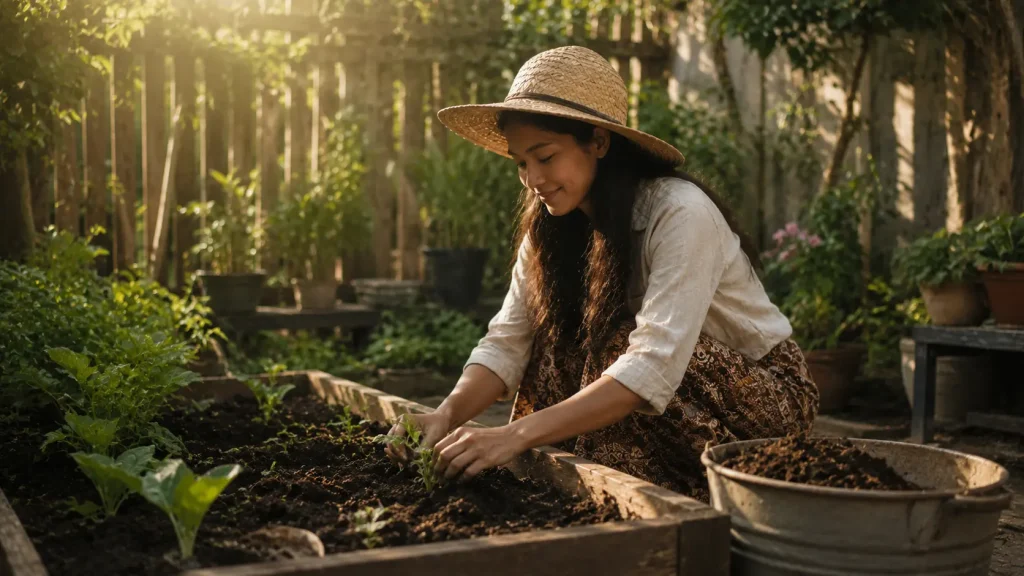
The Philosophy Hidden Inside Wet Soil and Food Scraps
Lately, one of the deepest lessons about inner peace has come from something incredibly simple: composting organic waste in my small garden.
At first, it seemed insignificant.
Just food scraps returning to the earth.
Vegetable peels. Wilted leaves. Leftovers from the kitchen. Things most people consider useless or unpleasant.
But the more I interacted with the soil, the more I realized it was quietly teaching me something profound about acceptance.
The earth does not reject decay.
The soil does not shame what is broken.
It receives everything.
Patiently.
Silently.
Without judgment.
And through time, what once appeared worthless transforms into nourishment for new life.
That realization touched me deeply because I recognized myself inside that process.
For years, I treated many parts of myself like emotional waste.
My grief.
My fear.
My insecurity.
My loneliness.
My attachment.
My sadness.
I wanted to throw them away as quickly as possible because I believed peaceful people were not supposed to feel those things.
But nature was teaching me another way to exist.
Instead of rejecting painful emotions, what if I allowed them to decompose naturally within awareness?
What if healing was less about elimination and more about transformation?
The compost in my garden slowly became a reflection of my inner world.
Nothing in nature is wasted.
Not even decay.
What appears broken eventually becomes nourishment for something else.
And perhaps the same is true for the human heart.
Maybe grief can deepen compassion.
Maybe loneliness can deepen tenderness.
Maybe fear can deepen humility.
Maybe pain itself can become fertile soil for wisdom.
The earth understands this instinctively.
Human beings often forget.
Returning to the Earth, Returning Home
The earth has quietly become one of my greatest teachers.
It never rushes.
Yet nothing fails to grow through it.
It understands timing without anxiety. It transforms everything slowly, honestly, and without performance.
And perhaps this is why touching the soil feels strangely healing to me now.
When my hands enter the earth, my nervous system softens. My breathing slows down. The noise inside my mind becomes quieter for a moment.
I remember that I am not separate from life.
I am part of it.
Modern life often disconnects us from this truth. We spend so much time inside screens, expectations, deadlines, comparisons, and overstimulation that we slowly lose touch with the deeper rhythms of existence.
But nature still remembers.
The trees remember stillness.
The rain remembers surrender.
The soil remembers patience.
And somewhere beneath all our anxiety, the body remembers too.
This realization completely changed my understanding of spirituality.
True spirituality no longer feels like escaping humanity.
It feels like returning more honestly to it.
It means becoming fully present inside ordinary life instead of trying to transcend it entirely.
It means recognizing that there is no separation between the sacred and the mundane.
Washing dishes can be sacred.
Gardening can be sacred.
Resting can be sacred.
Grieving can be sacred.
Even sitting quietly beside your own sadness can become sacred.
Because presence itself is sacred.
Peace Is Not the Absence of Emotional Turbulence
One of the greatest misunderstandings I carried for years was believing peaceful people no longer experience emotional struggle.
Now I see how unrealistic that expectation truly was.
Peace does not mean becoming emotionless.
Peace means developing enough inner spaciousness to hold emotions without collapsing beneath them.
The ocean remains vast even during storms.
Likewise, the human heart can remain grounded even when emotions rise and fall across its surface.
There are still days when fear visits me.
There are still moments when attachment tightens inside my chest. There are still experiences that hurt deeply.
But now, instead of immediately resisting those feelings, I try to meet them with gentleness.
Not because I have mastered life.
But because I finally understand that being human was never the problem.
The real suffering came from rejecting my own humanity.
Nothing was wrong with my emotions.
I was simply exhausted from fighting them.
A Quiet Invitation for Anyone Feeling Overwhelmed
If your inner world feels unbearably noisy right now, I want to tell you something gently:
You do not need to become perfect before you deserve peace.
You do not need to eliminate attachment completely.
You do not need to silence every uncomfortable emotion.
And you do not need to transform yourself into someone emotionally untouchable.
Perhaps what you truly need is not harsher discipline, but softer acceptance.
Perhaps healing begins when you stop treating your heart like a problem needing constant repair.
Perhaps peace begins when you allow yourself to sit honestly beside what hurts.
If possible, go outside sometimes.
Touch the earth.
Sit beneath a tree.
Listen to the wind moving through leaves.
Observe how nature allows every cycle to exist without shame.
Blooming.
Decaying.
Resting.
Growing.
Beginning again.
Nature never apologizes for transformation.
Maybe you do not need to apologize for yours either.
A Nameless Space Within the Human Heart
Today, I no longer fear attachment the way I once did.
Not because I have transcended emotion, but because something inside me has become more spacious.
I trust that life will continue changing.
I trust that love will sometimes hurt.
I trust that grief and beauty often exist together.
And strangely, that trust itself feels peaceful.
There is a nameless space within the human heart that exists beneath all labels, philosophies, identities, and spiritual performances.
A quiet place untouched by comparison.
A place where we no longer need to pretend to be endlessly healed or emotionally invincible.
In that space, we are simply human beings learning how to live honestly.
Breathing.
Feeling.
Loving.
Grieving.
Softening.
Returning home to ourselves again and again.
And maybe that is enough.
Maybe peace was never about becoming someone else entirely.
Maybe peace begins the moment we finally allow ourselves to become fully human.
Books That Deeply Resonate With Inner Peace Reflective Essay
These books carry a similar emotional atmosphere to your essay: reflective, grounded, emotionally honest, and spiritually gentle without becoming preachy. They explore themes like attachment, acceptance, emotional healing, inner peace, nature, and learning how to sit quietly with human emotions.
This book feels incredibly close to the emotional heart of your essay. It explores how suffering, uncertainty, and emotional discomfort can become gateways toward compassion and peace instead of something we must escape.
One of its most powerful ideas is learning how to stay present with pain instead of fighting it — very similar to your reflections about ending the war against emotion.
Goodreads
When Things Fall Apart on Goodreads
Buy When Things Fall Apart on Amazon
This book beautifully explores the idea of becoming the observer of your thoughts and emotions rather than being controlled by them. It strongly resonates with your section about becoming “a silent witness” to inner turbulence.
Its tone is spiritual yet approachable, calm, and deeply introspective.
Goodreads
The Untethered Soul on Goodreads
Buy The Untethered Soul on Amazon
If the soil, compost, and nature symbolism are the emotional center of your essay, this book may feel like a spiritual companion to your writing.
It explores humanity’s relationship with the earth, gratitude, slowness, and the wisdom hidden inside nature. The emotional atmosphere is deeply reflective, earthy, and quietly sacred.
Goodreads
Braiding Sweetgrass on Goodreads
Buy Braiding Sweetgrass on Amazon
This book speaks deeply about uncertainty, impermanence, and humanity’s attempt to control life. It mirrors the spirit of your reflection on holding life with open hands instead of clinging tightly to permanence.
Philosophical, reflective, and surprisingly comforting.
Goodreads
The Wisdom of Insecurity on Goodreads
Buy The Wisdom of Insecurity on Amazon
This book feels emotionally similar to your writing style: soft, intimate, reflective, and emotionally grounded.
It explores emotional exhaustion, burnout, loneliness, and the importance of allowing ourselves to move through difficult seasons instead of resisting them.
Very gentle. Very human.
Goodreads
This book beautifully captures the sacredness hidden inside ordinary life. Small moments, gardens, human connection, weather, tenderness, and quiet joy become reflections of deeper meaning.
It resonates strongly with the grounded and everyday spirituality found in your essay.
Goodreads
The Book of Delights on Goodreads
Buy The Book of Delights on Amazon
If this reflective essay resonated with you, these books may also feel like quiet companions for your inner journey. Each one explores themes of attachment, acceptance, emotional healing, nature, and finding peace within ordinary human life.
FAQ Section (SEO Friendly)
Frequently Asked Questions
What is a reflective essay about inner peace?
A reflective essay about inner peace explores personal experiences, emotions, and self-awareness in order to understand how peace can be found within everyday life. It often combines introspection, emotional honesty, and philosophical reflection.
How can attachment and acceptance create inner peace?
Inner peace often emerges when people stop fighting their emotions and begin accepting them with awareness. Attachment becomes less painful when it is approached with openness rather than control or fear.
Why is acceptance important for emotional healing?
Acceptance allows emotions to exist without shame or resistance. Instead of suppressing difficult feelings, acceptance creates space for transformation, self-understanding, and emotional growth.
How does nature help with emotional healing?
Nature can help calm the nervous system and reconnect people with slower, more grounded rhythms of life. Activities like gardening, touching soil, or spending time outdoors often encourage mindfulness and emotional clarity.
What does grounded spirituality mean?
Grounded spirituality focuses on being fully present in ordinary human life rather than escaping it. It emphasizes emotional honesty, self-awareness, compassion, and finding meaning in everyday experiences.
Is letting go the same as emotional detachment?
No. Letting go does not mean becoming emotionally numb or distant. Healthy letting go means loving and appreciating people or experiences without trying to control or possess them.
Can emotional pain lead to personal growth?
Yes. Emotional pain, when processed with awareness and acceptance, can deepen compassion, wisdom, resilience, and self-understanding over time.